Lecture
 | Binary Number Systems |
Key Concepts
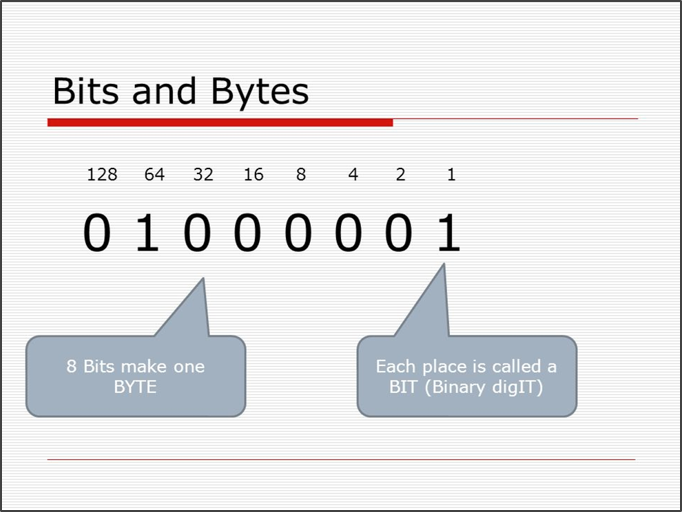
Bits
“The bit is a basic unit of information in information theory, computing, including digital communications. As a binary digit, the bit represents a logical state, having only one of two values. It may be physically implemented with a two-state device. These values are most commonly represented as either 0 or 1” (Wikipedia)
Bytes
“The byte is a unit of digital information that most commonly consists of eight bits. Historically, the byte was the number of bits used to encode a single character of text in a computer and for this reason it is the smallest addressable unit of memory in many computer architectures” (Wikipedia)
Binary
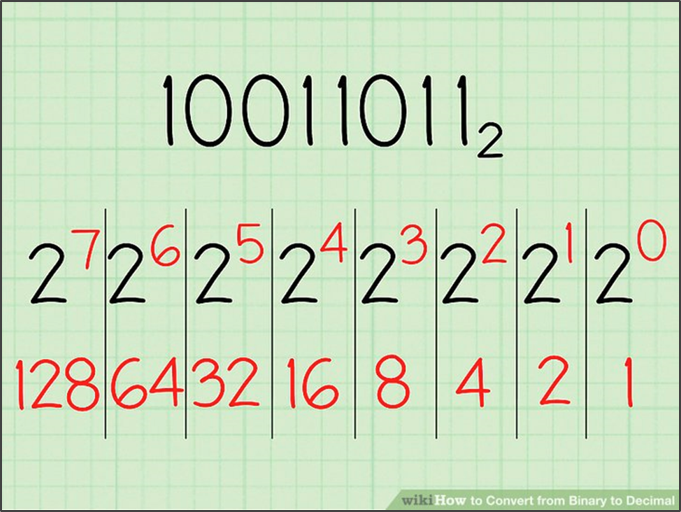
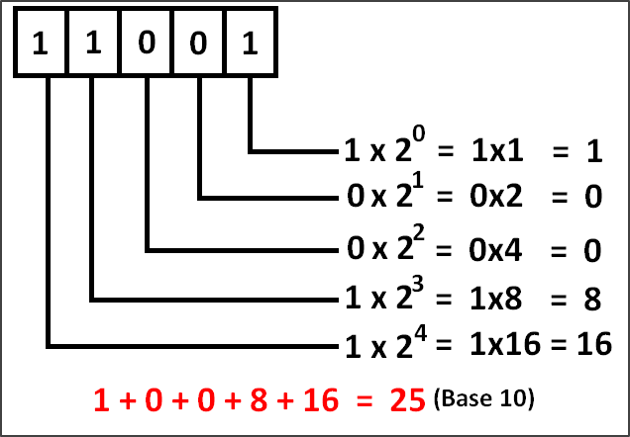
In mathematics and digital electronics, a binary number is a number expressed in the base-2 numeral system or binary numeral system, which uses only two symbols: typically ‘0’ (zero) and ‘1’ (one). The base-2 numeral system is a positional notation... Each digit is referred to as a bit. Because of its straightforward implementation in digital electronic circuitry using logic gates, the binary system is used by almost all modern computers and computer-based devices" (Wikipedia)
Unit Conversions
Kilobyte KB = 1,000 Bytes
Megabyte MB = 1 million Bytes
Gigabyte GB = 1 billion Bytes
Terabyte TB = 1 trillion Bytes
Pattern Ranges
One bit gives us two patterns: 1 and 0. Two bits allow for four patterns: 00, 11, 01, 10. Every time we add one bit to the length of our bitstring, we double the number of available patterns. So, 8 bits or 1 byte provides a means for representing 256 different patterns, as illustrated below:
1 bit – 2 patterns (21)
2 bits – 4 (22)
3 bits – 8 (23)
4 bits – 16 (24)
5 bits – 32 (25)
6 bits – 64 (26)
7 bits – 128 (27)
8 bits – 256 (28)
n bits - 2n patterns
Comprehension Check
 | Binary Number Systems Comprehension Check |
Application
Resources:
Q1: What would a byte representing the decimal number 0 look like?
Q2: Calculate the value of byte 01101101.
Q3: How would you representing the decimal number 40 using binary digits?