
Course Activities#
Assignment |
Frequency |
|---|---|
Content Reflections |
Weekly (weeks 1-13) |
Individual Application |
Weekly (weeks 1-13) |
Collaborative Problem Solving |
Weekly (weeks 1-12) |
Concept Maps |
Two (total) |
Personal Statement |
One (total) |
Final Project |
One (total) |
Content Reflections#
Assignment Prompt
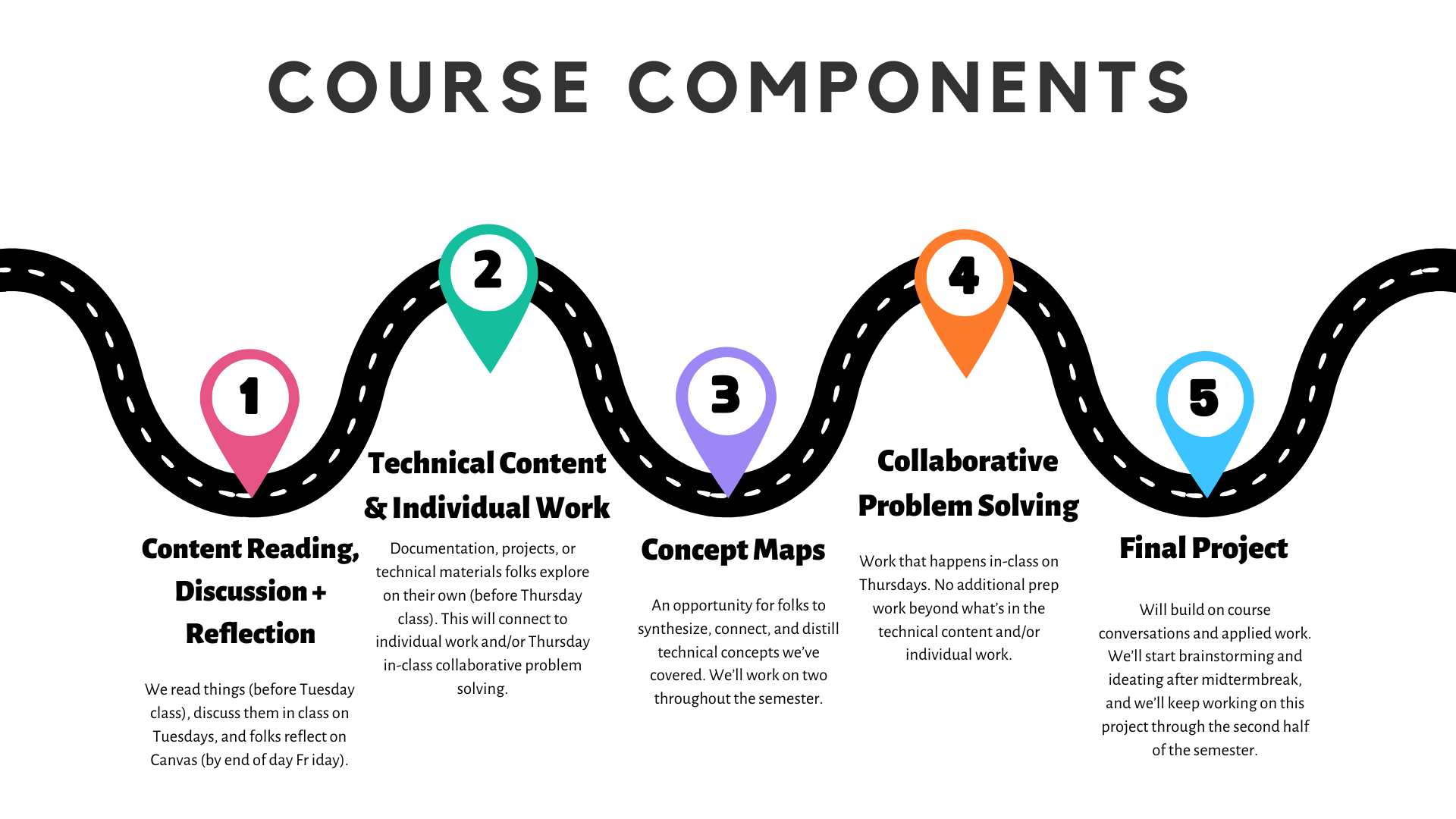
For most weeks with content, you’re asked to engage with the assigned material via an individual reflection.
Effective reflections move beyond summary or description of assigned material and course content toward an analysis that draws on your observations, experiences, and engagement with course material.
Effective reflections synthesize, analyze and thoughtfully evaluate concepts, as well as information introduced in assigned material and other elements of the course.
The reflections provide accountability for engaging with assigned content, but they are also an opportunity to examine your personal experience, course materials, and observations, carefully selecting key details, sources, and experiences as evidence to support your analysis and reflection.
These weekly reflections are a body of work that over the arc of the semester give you an opportunity to critically interrogate and reflect on the questions this course asks about how we conceptualize and engage with computing, data and technology.
These reflections could take a variety of forms–written text, recorded audio, recorded video, concept map or sketch notes, etc.
Length guidelines (only one format is required):
Written text (at least 300 words in length)
Recorded audio/video (at least 2 minutes)
Visual media (consult with the instructor if you have questions)
If citing course content, parenthetical citations (e.g. Mahoney, 144) are fine. No additional formatting expectations or parameters.
Individual Application#
Assignment Prompt
Throughout the semester, we will work through a number of modules or exercises designed to increase your comfort level and proficiency with specific computing concepts.
In other courses, you may have experienced an instructor delivering a lecture over specific concepts and then been assigned a homework problem set that asks you to apply concepts from a lecture and/or textbook reading.
This course uses a modified version of that approach. Working through the foundational concepts on your own outside class time (with additional support available as needed) means that we’re able to use in-class time for answering questions you have, working on more complex application scenarios, and building collaborative problem solving skills.
Individual work will typically include the following components:
Pre-recorded lecture/live coding content (videos on Panopto), detailed content notes
Engage with on your own time outside class
Preliminary application questions/tasks
Complete on your own outside class
What gets submitted on Canvas documents your experience completing the preliminary application questions/tasks. You are also welcome (and encouraged) to include any other questions or observations that come as you’re working through this material.
Collaborative Problem Solving#
Assignment Prompt
Throughout the semester, we will work through a number of collaborative problem-solving tasks designed to give you opportunities to apply skills and concepts covered in the class.
A large body of computing education research indicates that collaborative problem-solving strengthens your understanding of concepts we’re covering in the course while also creating space to build other kinds of collaboration, communication, etc. skills. If you’re interested in learning more about this research, let Prof. Walden know- I’m happy to share more about why the course is designed this way!
NOTE: I know experiences with group work can vary widely. One aspect of creating a rich collaborative learning environment involves clear expectations and frameworks that can help facilitate effective work in groups–that’s partly my (Prof. Walden’s) job. The other aspect of effective collaboration involves your preparation and active engagement. This kind of process-oriented, guided-inquiry learning is most effective when students are interacting with and learning from each other.
Practically, that means that we’ll spend the bulk of class time on Thursdays applying the concepts we’re covering that week in real-world scenarios that benefit from multiple perspectives and forms of expertise to come up with a workable solution.
What this will typically look like during Thursday class meetings:
Class forms small groups & decides on group roles
Prof. Walden introduces the prompt/task/problem
Class works in small groups to develop a conceptual understanding of the problem space
Class works in small groups to develop a technical/programmatic solution
Small groups work with other small groups to refine their solution/response
Each group submits documentation of their work process
Typically, documentation from these collaborative work sessions will be due on Canvas at the end of class. How the groups submit documentation of their collaborative in-class work may vary from week to week.
Sometimes it might look like solving a problem with a clear solution
Other times it might involve a set of activities with reflection questions
Other times it might involve developing a more complex program
The instructor will provide clear instructions on what you’re expected to document (and how/where). The extent of the collaborative work will happen during class meeting time. That is, you are not expected to meet or work with your group outside class time.
If your group is not able to complete a task or solve a problem during class time, make sure everyone in the group has access to shared materials. Folks can continue working on the problem/task on their own and submit their work as part of the individual lab notebook, making sure to credit the contributions of other group members.
Personal Statement#
Assignment Prompt
By the end of the semester, you’ll have encountered a range of technical concepts, critical analysis, and most recently different value or ethical decision-making frameworks. You’ll also have heard from a number of different guests about the values, commitments, and obligations that shape their work in this space.
The personal statement is an individual assignment that gives you the opportunity to synthesize that work by articulating a personal value framework. This assignment has a couple key goals:
Reflect on and synthesize the key concepts, theories, and discussions covered in the course.
Articulate a personal value framework that demonstrates an understanding of computing’s ethical, cultural, and societal implications
The personal statement should be at least 500 words, excluding references- you are welcome to use a citation system of your choosing (APA, MLA, Chicago, etc). There are no additional formatting requirements. You should expect to spend 5-7 hours outside class time working on this assignment.
You’re welcome to write in the genre of a statement or reflection that uses first-person (“I”) language, but you could also explore other genres like a manifesto (or manifest-no) or Hippocratic oath. We’ll start exploring ways to approach this assignment in week #14.
Regardless of format or medium, you should include a few key components:
An introduction that reflects on how you understood the relationship between computing, ethics, culture, and society at the start of this course. Then, highlight specific moments or readings from the course that challenged, shifted, or deepened your thinking.
A personal value framework informed by your analysis of and response to specific concepts, theories, frameworks, etc. we have encountered throughout the course. This involves articulating your own positions or orientations, and putting them in conversation with concepts, arguments, and frameworks we have encountered throughout the semester.
NOTE: You are not being asked to synthesize or summarize course concepts, arguments, or frameworks. The emphasis here needs to be engaging with those materials in ways that supports, positions, or furthers your argument.
A conclusion that reflects on the process of developing and articulating your value framework. This is also an opportunity to consider how it might evolve over time.
Final Project#
Assignment Prompt
The final project for this course is an open-ended creation that engages topics, concepts, and other course elements. One of my goals for the final project is for you to have an opportunity to delve into and explore in greater depth an aspect of the course that interests you, while also having the opportunity to further develop skills you would like to hone.
This is an individual project.
Projects that could fulfill this assignment might include:
A research project (paper, poster, podcast, blog post, etc) that incorporates historical, ethnographic, or critical cultural methods and frameworks connected to the work of this class
Some type of creative work that engages the critical making practices covered in the course, including interactive text, hypermedia, computational poetry, or something else entirely….
Some type of original educational resource for one of the technologies or applications covered in class (i.e. in the model of Harvard’s Creative Computing curriculum, or something that could be used locally either through ACE, South Bend Code School, workshop at the Center for Civic Innovation or local public library, etc)
I will generally be open to final project ideas with a strong rationale and feasibility plan. Contact the instructor with questions.
Things to consider when weighing final project options:
Skills you bring to this course
Who the project is “for,” or who you might want to be in conversation with
What you might want or need to do with the project
What projects are feasible given any restrictions or access limits on campus spaces/resources
This includes thinking about what resources you would still be able to access in the event of disruption
I do not expect perfectly executed projects, I expect vigorous and documented attempts to learn to do something that challenges you. Choose an idea that excites you in some way, make a plan, start executing it, make observations, adjust the plan, repeat.
To document that iterative planning process, you’re also asked to include a written reflection (at least 250 words) that documents how you approached the final project/what you wanted to accomplish via the final project, resources consulted, how you handled challenges you encountered, key takeaways, etc.
The wide range of possible project directions makes it hard to have a single overarching criteria in terms of project length/scope. So we’ll approach this in terms of the number of hours you should expect to spend working on the final project.
Expect to spend at least 15 hours working on the final project. That includes brainstorming, meeting with the instructor, in-class work time, etc. If you’re working on a project that is not going to take that much time, think about how to add complexity or take on another smaller scale project.
We will move toward the final project in stages over the last few weeks of the semester:
Ideation/brainstorming
Proposal
In-class work time
Status update
Presentations
Final submission